
Modeling TBox (Terminology) and ABox (Assertions)
The Formal Separation: TBox and ABox
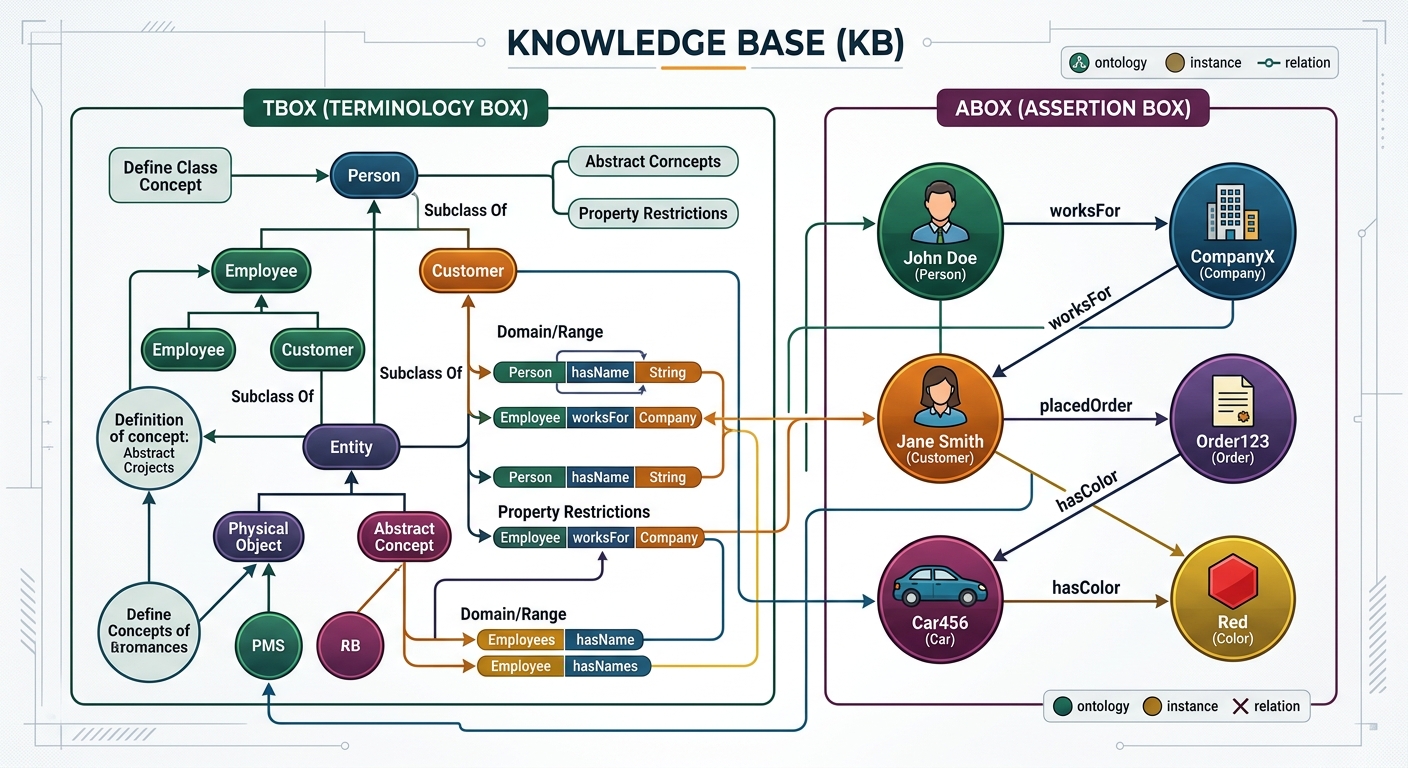
In Description Logic (DL), which forms the mathematical foundation of OWL (Web Ontology Language), a Knowledge Base (KB) is formally partitioned into two distinct components: the TBox and the ABox.
The TBox (Terminological Box) contains the schema, vocabulary, and structural axioms of your domain. It defines classes (concepts), properties (roles), and the logical constraints that govern them. When you declare that Employee is a subclass of Person ($Employee sqsubseteq Person$), or that the property manages has a domain of Manager and a range of Employee, you are building the TBox.
The ABox (Assertional Box) contains the instance data. It consists of assertions about specific, concrete individuals. When you state that :Alice is an Employee ($Employee(Alice)$), or that :Alice manages :Bob ($manages(Alice, Bob)$), you are populating the ABox.
The Class vs. Individual Confusion
A widespread modeling error among practitioners transitioning from object-oriented programming to ontology engineering is confusing classes with individuals. This directly leads to bloated TBoxes. For example, modeling MyHondaCivic as a subclass of Car rather than an individual instance of the class Car.
Why does this matter? TBox reasoning (classification, satisfiability checking) is computationally far more expensive than ABox querying. Description Logic reasoners are optimized to handle relatively small, complex TBoxes and massive, simple ABoxes. If you model millions of transient entities as classes, the reasoner will attempt to classify them within the TBox hierarchy, leading to exponential time complexity and out-of-memory errors.
As a rule of thumb: if an entity represents a set of things, it belongs in the TBox. If it represents a single, specific entity in the real world that cannot have instances of its own, it is an ABox individual.
An Introduction to Description Logic
Bridging the Divide: Nominals and Punning
While the TBox and ABox are conceptually distinct, modern semantic modeling requires mechanisms to bridge them. Two primary features in OWL 2 facilitate this: Nominals and Punning.
Nominals (the {a} constructor) allow you to define a TBox class by explicitly enumerating its ABox members. For instance, you can define the class PrimaryColor as exactly {Red, Green, Blue}. While highly expressive, heavy use of nominals shifts the underlying logic of your ontology (typically from $mathcal{SHIQ}$ to $mathcal{SHOIQ}$), which significantly increases the computational burden on the reasoner.
Punning (Metamodeling) in OWL 2 allows the exact same IRI to be used as both a class and an individual. For example, :Eagle can be modeled as an individual instance of the class :Species (an ABox assertion), while simultaneously acting as a TBox class for the individual :JoeTheEagle. Under OWL 2 Direct Semantics, the reasoner treats the class :Eagle and the individual :Eagle as semantically distinct entities, preserving decidability while allowing for flexible, multi-level modeling.
Reasoning Mechanics: OWA, UNA, and Consistency
Understanding how reasoners process the TBox and ABox requires unlearning assumptions from relational databases. OWL operates under the Open World Assumption (OWA). If an assertion is missing from the ABox, the reasoner does not assume it is false; it simply considers it unknown.
Furthermore, OWL lacks the Unique Name Assumption (UNA). Different URIs do not automatically imply different individuals. If your TBox states that a Department can have a maximum of one Manager (a cardinality restriction), and your ABox asserts that :SalesDept is managed by both :Alice and :AliceSmith, the reasoner will not throw an error. Instead, lacking UNA, it will logically infer that :Alice and :AliceSmith must be the exact same individual.
This behavior highlights a critical distinction: OWL cardinality is for inference, not validation. If you need strict data validation to ensure the ABox conforms to the TBox schema (e.g., throwing an error if two distinct managers are assigned), you should use closed-world constraint languages like SHACL (Shapes Constraint Language).
OWL 2 Profiles and Optimization
The World Wide Web Consortium (W3C) introduced OWL 2 Profiles to optimize reasoning for different TBox/ABox distributions:
- OWL 2 EL: Designed for ontologies with massive, highly complex TBoxes but relatively simple ABoxes. It is widely used in healthcare and life sciences (e.g., SNOMED CT) where the primary task is TBox classification.
- OWL 2 QL: Optimized for massive ABoxes. It allows complex conjunctive queries over the ABox to be rewritten directly into standard relational database queries (SQL) or SPARQL, making it ideal for ontology-based data access (OBDA).
- OWL 2 RL: Tailored for rule-based reasoning over large ABoxes. It maps OWL semantics to IF-THEN rules, allowing efficient execution by rule engines.
By strictly differentiating your terminology (TBox) from your assertions (ABox), and selecting the appropriate OWL profile, you ensure that your enterprise knowledge graph remains logically consistent, computationally tractable, and ready to serve as high-quality structured context for AI and GraphRAG applications.