
Explaining Model Decisions to Customers and to Supervisors
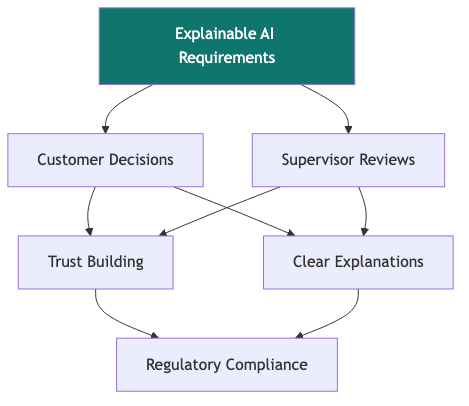
Explaining model decisions to customers and supervisors is a core element of AI governance in financial services. The ability to provide clear, understandable explanations of AI-driven decisions is not only a regulatory expectation but also a practical necessity for maintaining trust and accountability. In the UK, financial institutions must ensure that AI systems used in decision-making processes are explainable, especially when those decisions affect customers or are reviewed by supervisors.
Understanding the Need for Explainability
Financial institutions increasingly rely on machine learning models to assess credit risk, detect fraud, or recommend investment strategies. These models often operate as “black boxes,” making complex decisions based on large datasets. However, under existing UK rules and EU AI legislation, such as the EU AI Act, explainability is required. For example, Article 5 of the EU AI Act prohibits certain high-risk AI systems from being used unless they meet transparency requirements. This includes systems that make decisions affecting individuals, such as credit scoring or insurance underwriting.
When explaining decisions to customers, financial firms must ensure that the explanation is meaningful and accessible. For instance, if a customer is denied credit based on an AI model, they must be provided with a reason that makes sense to them. This might involve explaining which data points contributed to the decision, such as credit history or income level, rather than simply stating that the model “rejected” the application. The goal is to ensure that customers understand the logic behind the decision, even if they cannot access the underlying model architecture.
Communicating with Supervisors
Supervisors, including those from the FCA or Prudential Regulation Authority (PRA), expect detailed documentation of AI decision-making processes. This includes not only technical explanations but also governance frameworks that demonstrate how models are monitored, tested, and reviewed. For example, a supervisor might ask for an explanation of how bias was identified and mitigated in a credit scoring model. The response must be grounded in data, such as demographic breakdowns of model outcomes or audit logs of model updates.
Effective communication with supervisors also involves demonstrating compliance with relevant standards such as ISO/IEC 42001:2023. This standard provides a framework for managing AI systems through an AI management system. Firms that have adopted this standard must be able to show how their processes align with its clauses, such as Clause 7.2 on AI risk management or Clause 8.3 on AI monitoring. The ability to articulate these processes clearly helps supervisors understand that the firm is actively managing AI risk, not merely deploying models without oversight.
- Ensure explanations are tailored to the audience, whether customer or supervisor
- Document decision-making processes to support regulatory scrutiny
- Link explanations to data, such as feature importance or model validation results

Best Practices for Decision Transparency
To meet these expectations, firms should develop a structured approach to explaining AI decisions. This involves creating standardized templates or frameworks that can be applied across different models and use cases. For example, a credit decisioning framework might include sections such as “Data Used,” “Model Outputs,” and “Decision Rationale.” These sections should be reviewed regularly to ensure they remain aligned with evolving regulatory expectations and internal processes.
Training staff on how to explain AI decisions is also essential. This includes not only technical staff but also customer-facing roles such as relationship managers or customer service teams. These individuals must understand the limitations of AI models and be able to communicate these clearly to customers. For example, if a customer asks why their loan application was denied, a representative should be able to refer to the model’s output and explain the key factors, such as credit score or debt-to-income ratio, without revealing proprietary or sensitive data.
In addition, firms must ensure that explanations are provided in a timely manner. The EU AI Act’s transparency duties, which apply from 2 August 2026, require that individuals have access to explanations of AI-driven decisions. This is particularly important for high-risk AI systems, such as those used in financial services. Firms must have processes in place to respond to these requests, whether through automated systems or through designated personnel.
Lastly, firms should consider the broader implications of explainability on AI governance. The ability to explain decisions is not just a compliance requirement but also a tool for continuous improvement. Regular reviews of explanations can reveal biases or inconsistencies in models, which can then be addressed through retraining or model redesign. This feedback loop is central to maintaining the integrity of AI systems in financial services.